

Who Do You Think You Are?
Jantelagen and what a Swedish flatmate taught me about fitting in versus standing out.

Years ago, I was living with a Swedish flatmate in London. We’d gotten into one of those long kitchen-table conversations about culture – the kind that changes how you see things.
I’d been telling him how drawn I was to the Nordic way of life. The sense of community. The idea that people look out for one another rather than just looking out for themselves. Sweden has a tradition called Fredagsmys – cozy Fridays – where they stay in with friends or family, watch films, and eat tacos (Swedes love their Tex-Mex!). I was romanticizing it, I know.
But as someone who has always been drawn to the “it takes a village” philosophy – maybe that’s the harmony-seeking Enneagram 9 in me – I loved the idea of “we“ over “I.”
Then he said something I hadn’t expected.
“It can also be suffocating,” he said. “You aren’t really encouraged to be an individual. There’s enormous pressure to conform. And if you stand out – if you seem too ambitious or too different – people will let you know.”
He told me that was one of the reasons he’d left Sweden. He wanted the freedom to explore, to pursue a creative career, to say what was on his mind.
That conversation stuck with me because it captured something I think about constantly – both personally and in my work as a coach: Our greatest strength can also be our biggest weakness, as individuals and as wider cultures.

The Law of Jante: You’re not special
In Nordic culture, there’s an unwritten social code called Jantelagen – the Law of Jante. It’s a set of rules that essentially say: Don’t talk about your achievements, don’t flaunt your goals or dreams, and above all, don’t get the idea that you’re better than anyone else. Blend in. In Australia, a similar concept goes by a different name: Tall Poppy Syndrome – stand too tall, and they’ll cut you down.
The roots run deep. Sweden was historically a rural society of small, independent farmers who depended on cooperation to survive. Disrupting group cohesion wasn’t just rude – it was dangerous. The Lutheran church reinforced this with its emphasis on humility: Pride is a sin; the collective matters more than the individual. In more recent decades, Sweden’s social system has formalized these values through high taxes, group decision-making, and an ethos of equality.
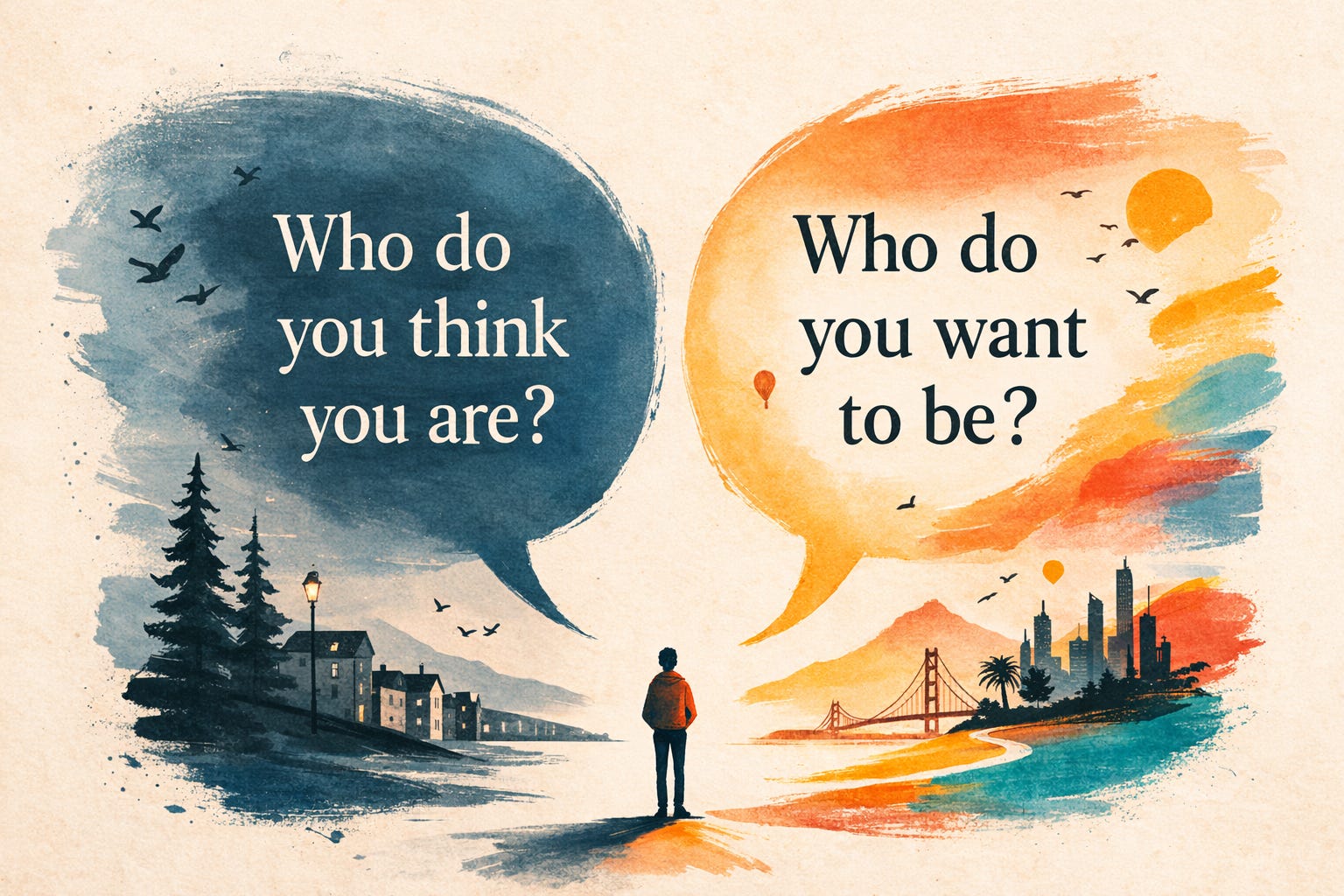
Swedish culture says “Who do you think you are?” as a warning.
Today, many Swedes – especially younger, more entrepreneurial ones like my former flatmate – are pushing back. They value openness, creativity, and self-expression. There’s even a running joke that the reason Scandinavians drink so much is that it’s the only time they feel free to say what’s really on their mind.
To me, there are genuinely honorable values at the heart of Jante – equality, humility, a commitment to the common good. But they’re wrapped in norms that many people experience as limiting rather than liberating.

Rugged Individualism: Who do you want to be?
American culture asks a very different question: “Who do you want to be?”
This makes sense when you consider the U.S.’s origin story. The Europeans who came to America were, by definition, risk-takers – people willing to break from their communities, cross an ocean, and start over. Our founders studied Enlightenment philosophers who wrote about individual liberty. The frontier rewarded self-reliance. Every generation, new immigrants come with the belief that you can build a better life than the one you were born into.
We celebrate victories in America. We cheer people on when they get a promotion or win a race. The American Dream is fundamentally a story about the individual.
But of course, it’s not so simple. The Pilgrims survived their first winter by working as a collective. Social media will remind you that plenty of Americans are jealous of other people’s success and eager to tear down anyone who stands out too much. And the flip side of celebrating the individual is leaving the individual to fend for themselves.
Our safety net is thin compared to Europe’s, and income inequality has never been greater – the wealthiest 1% of Americans now hold as much total wealth as the bottom 90% of the country combined. The can-do spirit and opportunity is real, but it’s not equal opportunity or an equal playing field. Some people benefit from generational wealth, mentors, and Ivy League networking, and others are told to pick themselves up by their bootstraps and hustle.
What I discovered about myself in Italy
If I could design my own ideal society, I’d blend Sweden’s care for the collective with America’s belief that things are possible.
I realized this when I moved to Reggio Emilia, Italy, in 2010. It’s a charming town where you can enjoy an Aperol spritz in a gorgeous piazza as the sun sets. I had come from New York City, and the locals couldn’t believe it.
“Are you crazy?” they’d say. “Why would you leave New York to come here? There’s nothing here. Can I trade places with you?”
What struck me was the stuckness. So many people I talked to felt they could never leave a job because what if they didn’t find another one? The future felt hopeless.
It was then that I realized something about myself: I was more American than I’d thought. I had inherited something from my Sicilian and Polish and Ukrainian and Lithuanian ancestors – the people who crossed oceans to start again:
I believed – and believe – that the future is full of possibilities. That, while many things are out of my control, I can influence the kind of life I want to live. That if I want to try something, I should roll up my sleeves and try it. I like that about myself and about my home country.
Why this matters – especially at work
As a coach and a practicing Stoic, perspective-taking is at the heart of what I do. The Stoics would say: Take off your blinders. See the situation from every side before you respond. This skill prevents so much heartache and misunderstanding, at home and at work.
This is especially true for anyone managing global teams or working with people from different cultural backgrounds.
When a Swedish colleague seems reluctant to share his accomplishments, he may not lack confidence – he might be following a deeply ingrained cultural script. When an American colleague shares a win she’s proud of, she might not be arrogant – she’s doing what her culture taught her to do. When an Italian colleague seems resistant to change, he may not be lazy – he may be fearful of the future because his culture prized stability.
Once we talk to people and have a better understanding of where they are coming from, you can decide how to move forward together.
Choosing how you show up
We don’t get to choose the culture we grow up in. But we can choose how we show up now. We can choose to live according to our own values, no matter where we are in the world. And we can choose to extend curiosity to the people around us – to learn their history, understand their culture, and see them as individuals shaped by forces much bigger than any single decision.
My flatmate in London taught me that what looks like a blessing from the outside can feel like a cage from the inside. Reggio Emilia taught me that the spirit I’d taken for granted – the belief that I can try for things – was a gift worth holding onto.
And years of coaching have taught me that we are influenced not just by our families but by our broader cultures. At the foundation of it all is our natural temperament – our strengths and weaknesses, our clarity and blind spots. We can keep what’s working and look outside ourselves for inspiration on the things we want to change.
Swedish culture asks, “Who do you think you are?” American culture asks, “Who do you want to be?” Maybe the wisest question is a third one: “Who are we, together?”
Sarah Mikutel is an American in England who coaches clients around the world. www.sarahmikutel.com